Postwar occupation and social transformation in Japan
A Pale View of HillsPostwar occupation and social transformation in Japan emerges through a conflict over what the country has lost and what it may be gaining. In remembered conversations and observations from postwar Nagasaki, the changes associated with the Americans unsettle older ideas of discipline, family loyalty, and education. Ogata-San sees democracy as a language used to abandon obligations; Jiro’s qualified replies expose the failures concealed by his father’s nostalgia. The contrast makes social change neither a simple national recovery nor a straightforward decline, but a struggle over which parts of the past deserve to endure.
Occupation and the argument over change
The occupation’s approaching end is a recurring subject in the neighborhood that summer. Newspapers report on it, while politicians in Tokyo argue; among residents of the apartments, however, the issue is discussed with a cynicism resembling their resigned talk about the wasteground. The juxtaposition places a major political transition beside the mundane frustrations of local life. The occupation is a public question, but its meaning is also worked out in domestic conversations and in the habits people are trying to preserve or discard.
Ogata-San interprets the arrival of American ideas as a sharp break with Japanese social arrangements. He particularly objects to spouses voting for different parties, treating the wife’s independent choice not as an ordinary political difference but as evidence that household loyalty has weakened. In his account, democracy has become the justification for acting on personal preference instead of fulfilling duties to family, superiors, and country. He fears that a principle associated with political freedom has entered private life in a form that loosens the ties that once held society together.
His complaint is not limited to voting. Ogata-San describes the school system as an institution carefully nurtured over many years, then dismantled by the Americans and replaced with schools modeled on their own. He believes the changes discarded valuable forms of instruction as well as familiar authority. His anxiety centers on the transmission of values: he imagines young people receiving little guidance beyond encouragement to demand what they want, while their parents themselves disagree over political loyalties. The family and the school become, in his account, connected sites where the weakening of inherited discipline is made visible.
Education, memory, and the limits of nostalgia
As a former teacher who says he devoted his life to educating the young, Ogata-San regards the transformation of schooling as a personal loss as well as a national one. He laments that children leave school without knowing their country’s history and recalls an older educational purpose: cultivating qualities and attitudes toward the country and other people. His defense rests on the belief that education once gave Japan a shared spirit. The intensity of that conviction helps explain why he experiences reform not merely as curricular change, but as the destruction of a moral structure he helped sustain.
Jiro does not simply accept this account. He recalls being taught that Japan had been created by gods and was divine and supreme, with pupils required to memorize the textbook word for word. That memory gives the dispute a concrete counterweight: the system Ogata-San mourns also transmitted nationalist claims that Jiro now regards as questionable. He concedes that some omissions in the new schools may be regrettable, but insists that parts of the old education were no loss. The exchange therefore separates the preservation of historical knowledge from the restoration of indoctrination; one does not automatically require the other.
Ogata-San resists that distinction. He tells Jiro that the workings of the old system were not so simple and emphasizes its aims of passing proper qualities from one generation to the next. He remembers men such as Endo and himself as having done their best to nurture what was good in the country. His final insistence that much good has been destroyed gives the conversation the shape of a defense of a life’s work, even as Jiro’s recollection reveals why that work cannot be accepted without qualification.
Domestic conflict as a measure of social change
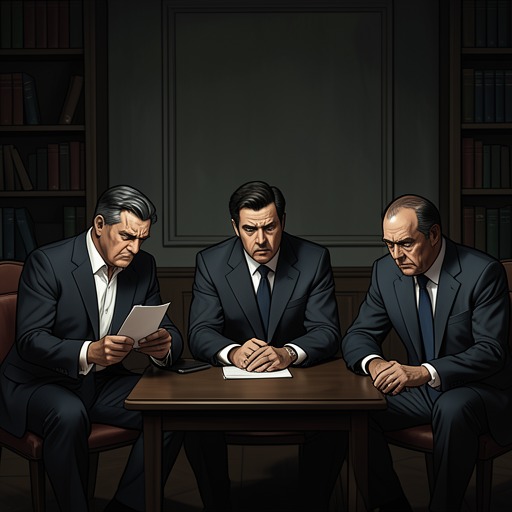
The exchange between father and son makes national transformation intimate. Ogata-San’s example of husband and wife supporting different parties turns electoral pluralism into a test of marital and household loyalty. Jiro answers deferentially, repeatedly acknowledging his father’s point, yet introduces objections rather than endorsing the whole argument. His brief responses, glance back at the newspaper, yawn, and eventual departure for bed leave the disagreement unresolved. The scene shows the older man continuing to speak from an inherited authority while his son no longer gives that authority unquestioned assent.
Their different positions do not divide neatly into an old Japan and an entirely embraced new order. Ogata-San recognizes that change has occurred but interprets it as a loss of duty; Jiro recognizes the possible value of preserving history but remembers how schooling made divine national supremacy an unquestionable lesson. The conversation thus records a generational contest over who may define the nation’s past and what obligations can still be demanded in its name. Democracy appears at once as a political import in Ogata-San’s complaint and as the setting in which his son can challenge the education that formed him.
Postwar unease in Nagasaki
The narrator’s recollection places these ideological disputes within a summer of uneven, incomplete change. The approaching end of the occupation and political argument in Tokyo receive neighborhood attention, but local conversation remains marked by cynicism. More immediate fear comes from reports of child murders in Nagasaki: after a boy and a girl are reported killed, the discovery of a third young victim prompts near-panic among mothers. Children become uncommon around the housing precinct, particularly in the evening. The account does not make these crimes a consequence of the occupation; rather, their presence shows that political transition unfolds alongside dangers and anxieties that cannot be reduced to arguments about policy.
These parallel pressures complicate any account of postwar recovery as a single, orderly movement forward. Public debate concerns the end of occupation, the household becomes a site of disagreement over political independence, and the school stands at the center of a dispute over national memory. The remembered details do not resolve whether the new order has replaced the old with something better. Instead, they preserve the friction between Ogata-San’s fear that shared obligations are disappearing and Jiro’s evidence that some of the values once taught as national truth were themselves damaging. That unresolved friction is the subject’s central significance: transformation changes not only institutions, but also the grounds on which families and generations decide what is worth keeping.